
Spa Booking Tools That Run More Than a Calendar
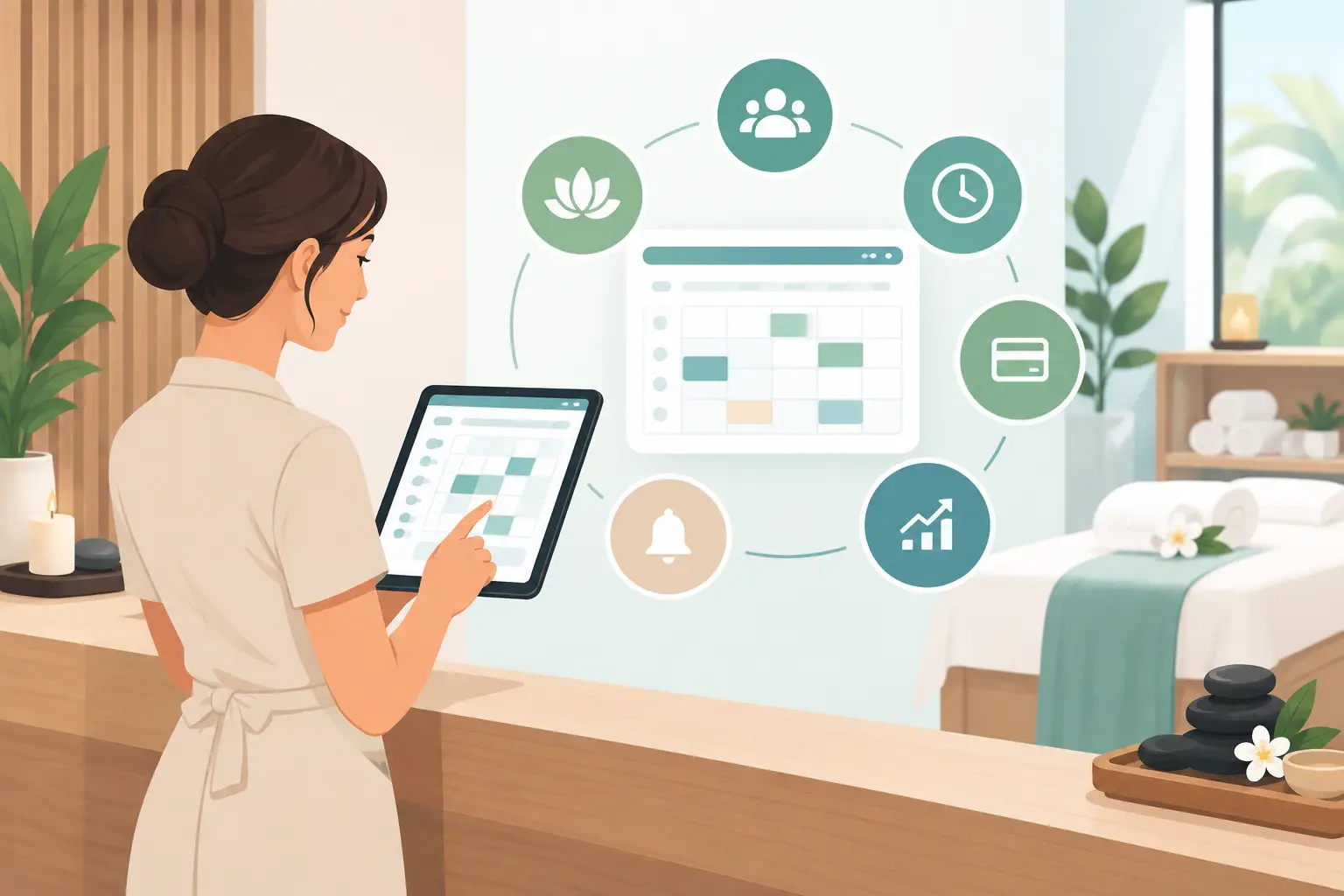
A fully booked Saturday can still be a difficult day to manage. A client needs to reschedule, a therapist calls out, a package balance is unclear, and the front desk is chasing a no-show payment. The right spa booking tools do more than fill open time slots. They give your team a reliable way to manage the full client journey without moving between disconnected systems.
For spa owners and managers, the question is not simply whether clients can book online. It is whether every booking creates the information, payment process, staff coordination, and follow-up needed to run a more controlled business.
What spa booking tools should actually solve
A calendar is necessary, but it is only one part of spa operations. When scheduling, client records, payment tracking, staff availability, marketing, and reporting live in separate places, routine work turns into manual reconciliation. Your front desk may have the appointment details, while treatment preferences sit in a notebook, deposits are in another system, and customer follow-up depends on someone remembering to send it.
That fragmentation affects the client experience as much as internal efficiency. A returning guest should not have to repeat preferences at every visit. A team member should be able to see relevant booking notes before a treatment begins. Managers should not need to assemble several reports just to understand which services, staff members, or campaigns are producing revenue.
A capable platform brings these workflows together. It lets clients book through a branded online page while the business manages the operational work behind the booking from one dashboard. That means appointments are connected to customer history, assigned staff, payment status, communications, and performance data.
The operational features that matter most
The best fit depends on your spa's size, service menu, and operating model. A solo esthetician has different requirements than a multi-room day spa with a front-desk team. Still, a few capabilities have a direct impact on daily control and revenue.
Online booking that reflects your business
Your booking experience should make it easy for clients to choose a service, provider, date, and time without calling the front desk. More importantly, it should reflect the way your spa actually operates. Service durations, buffer time, practitioner availability, room constraints, and booking rules all affect whether an online appointment can be delivered profitably.
Look for a branded booking page rather than a generic marketplace-style profile. Your clients should recognize your business, and your team should retain ownership of the customer relationship. Clear service descriptions and accurate availability reduce booking friction while helping guests arrive with the right expectations.
Consider how the system handles the exceptions that create front-desk workload. Can you set cancellation windows, require deposits, limit last-minute bookings, or block time for staff meetings and inventory? These are not minor settings. They protect capacity and give your team fewer problems to solve manually.
Client records that support better service
Every visit should add useful context to the client record. Booking history, treatment notes, preferences, purchase activity, contact details, and communication history help staff deliver a more personal experience without relying on memory.
Centralized records are particularly valuable when multiple team members serve the same client. A guest may book a massage with one provider, return for skin care with another, and purchase a package at the front desk. If the information is scattered, the experience feels disconnected. If it is available in one place, your team can recognize the relationship and make relevant recommendations.
The goal is not to collect data for its own sake. It is to give staff the context they need at the moment they need it, while giving managers a clearer view of retention and client value.
Staff scheduling and accountability
Staff availability is a revenue input. If schedules are inaccurate or difficult to update, open capacity is lost and double-booking risk rises. A spa booking platform should make it straightforward to manage provider hours, time off, service eligibility, and assigned appointments.
For managers, visibility matters just as much as scheduling. You need to see where demand is strongest, whether certain services are underbooked, and how workload is distributed across the team. This supports better staffing decisions than simply reacting to a crowded calendar.
Be careful not to choose a tool based only on the number of calendar views it offers. The useful question is whether staff schedules connect to service rules, client bookings, payroll or commission processes where relevant, and performance reporting.
Payments, deposits, and policies built into the workflow
Payment handling should not be an afterthought added at checkout. Deposits, cancellation fees, prepaid packages, and payment records are closely tied to booking policies and client behavior.
A connected payment workflow helps reduce no-show exposure because the policy is applied when the appointment is made, not after capacity has already been lost. It also gives the front desk a clearer picture of what is due, what has been paid, and which clients have remaining package balances.
The right approach depends on your business. A small spa with low no-show rates may only need simple payment collection. A high-demand spa, or one offering long appointments and premium services, may benefit from deposits or stronger cancellation controls. The important point is that your policies should be consistent, visible to clients, and easy for staff to administer.
How to evaluate spa booking tools before you commit
A software demo can make almost any calendar look organized. To make a confident decision, evaluate the system against the real situations your team handles each week.
Start with the booking journey. Test what happens when a client wants a specific provider, needs to reschedule, buys a package, cancels close to the appointment, or books multiple services. Then examine the staff workflow. Can a team member quickly find the client record, see upcoming appointments, check payment status, and record the information needed after a service?
Next, look beyond the front desk. Ask how the platform helps you re-engage clients who have not returned, promote seasonal services, and measure campaign results. Marketing works better when it is connected to actual booking and client data rather than maintained as a separate contact list.
Reporting deserves the same scrutiny. Useful analytics should answer practical questions: Which services are growing? Where are cancellations occurring? Who are your most loyal clients? Which team members or booking channels are producing the most revenue? If reporting requires exports and spreadsheet work every week, the platform is not delivering the operational visibility it should.
Finally, consider adoption. The most feature-rich system will not improve operations if staff avoid using it. A clear dashboard, logical workflows, and accessible day-to-day tools matter. Training time is a real cost, but so is a system that forces your team to create workarounds.
Why consolidation creates better client retention
Spa growth often depends less on finding a new client than on giving existing clients a reason and an easy path to return. That requires more than sending occasional promotions. It requires knowing who visited, what they booked, how often they return, and when follow-up is most relevant.
When booking, CRM activity, campaigns, payments, and analytics are connected, your business can act on that information. You can identify clients who have not rebooked, target communications by service history, recognize frequent guests, and assess whether a campaign produced appointments rather than just opens or clicks.
This is where an all-in-one platform such as CleverBooking can make a practical difference. Instead of treating scheduling as a standalone function, it connects the branded booking experience to the customer, staff, financial, marketing, and reporting workflows that happen after the appointment is made.
Choose control, not just convenience
Convenience is a good starting point for spa booking software, but it is not the full standard. Clients want a fast, professional way to book. Your team needs accurate schedules and client context. Management needs clear payment processes, consistent follow-up, and dependable visibility into performance.
Choose a system that supports all three. When the booking process feeds the rest of your operation, every appointment becomes easier to deliver, easier to track, and more likely to lead to the next visit.